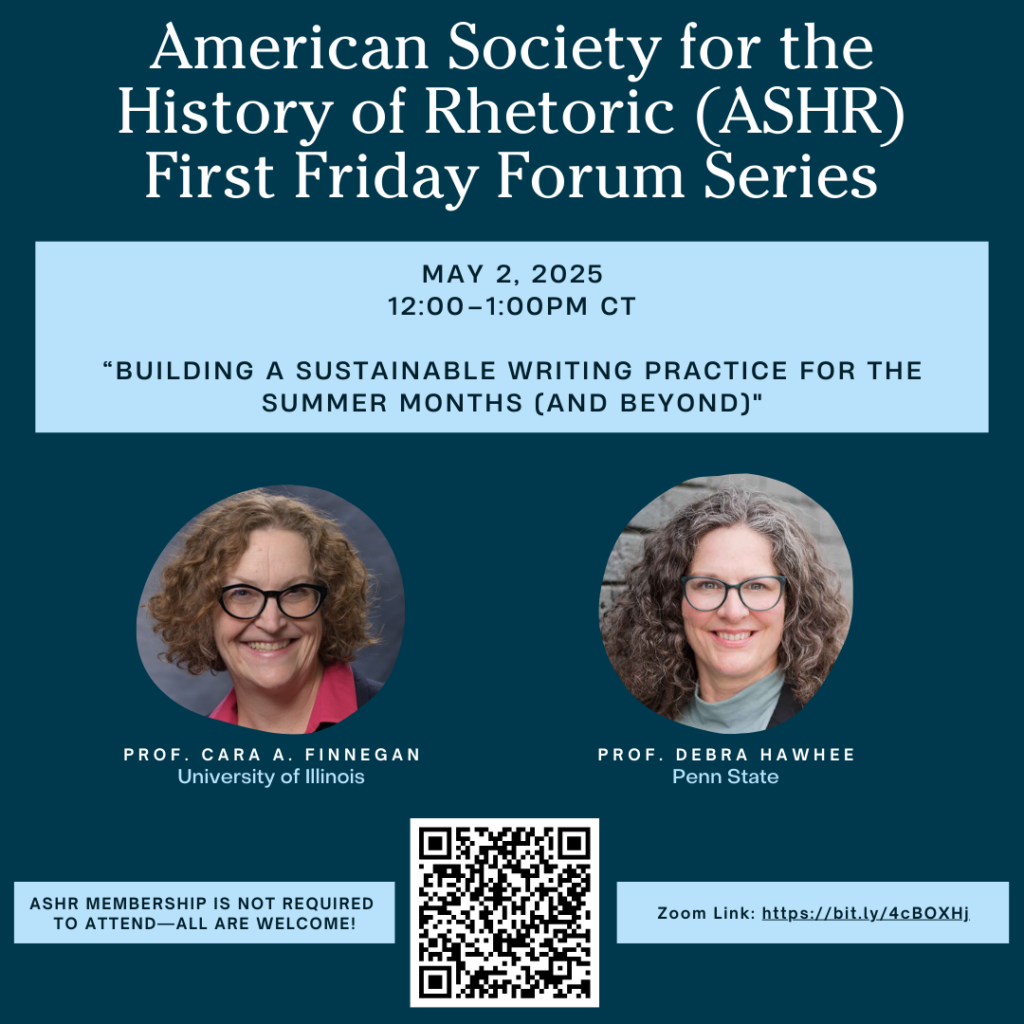
Building a Sustainable Writing Practice for the Summer Months and Beyond (May 2)

***Video recording available here for ASHR members.*** 

Friday, May 2, 2025, 12:00-1:00pm CT/1:00-2:00pm EST

Prof. Cara A. Finnegan, University of Illinois
Prof. Debra Hawhee, Penn State University

Academics often think of summer as a magical time when the demands of the typical academic year can be set aside so that we can finally turn to our writing and research. Overachievers that we are, we imagine that we will have time and energy to complete All The Things. All too soon, however, the fantasy of “all summer to write” fades into the reality of our actual lives and then we beat ourselves up for not getting it all done. This workshop will offer attendees strategies designed to skip the fantasy and instead develop a concrete, specific, sustainable writing practice that will set you up for your work this summer and beyond. Attendees should come with pen/paper/screen and a calendar and expect to leave with a doable summer plan in hand.

Resources for Writing Guidance and Inspiration:

Cayley, Rachael. Thriving as a Graduate Writer: Principles, Strategies, and Habits for Effective Academic Writing. University of Michigan Press, 2023. 

Germano, William. On Revision: The Only Writing That Counts. University of Chicago Press, 2021.

Jensen, Joli. Write No Matter What: Advice for Academics. University of Chicago Press, 2017.

Smith, Maggie. Dear Writer: Pep Talks & Practical Advice for the Creative Life. Washington Square Press, 2025.

Sword, Helen. Air & Light & Time & Space: How Successful Academics Write. Harvard University Press, 2017.
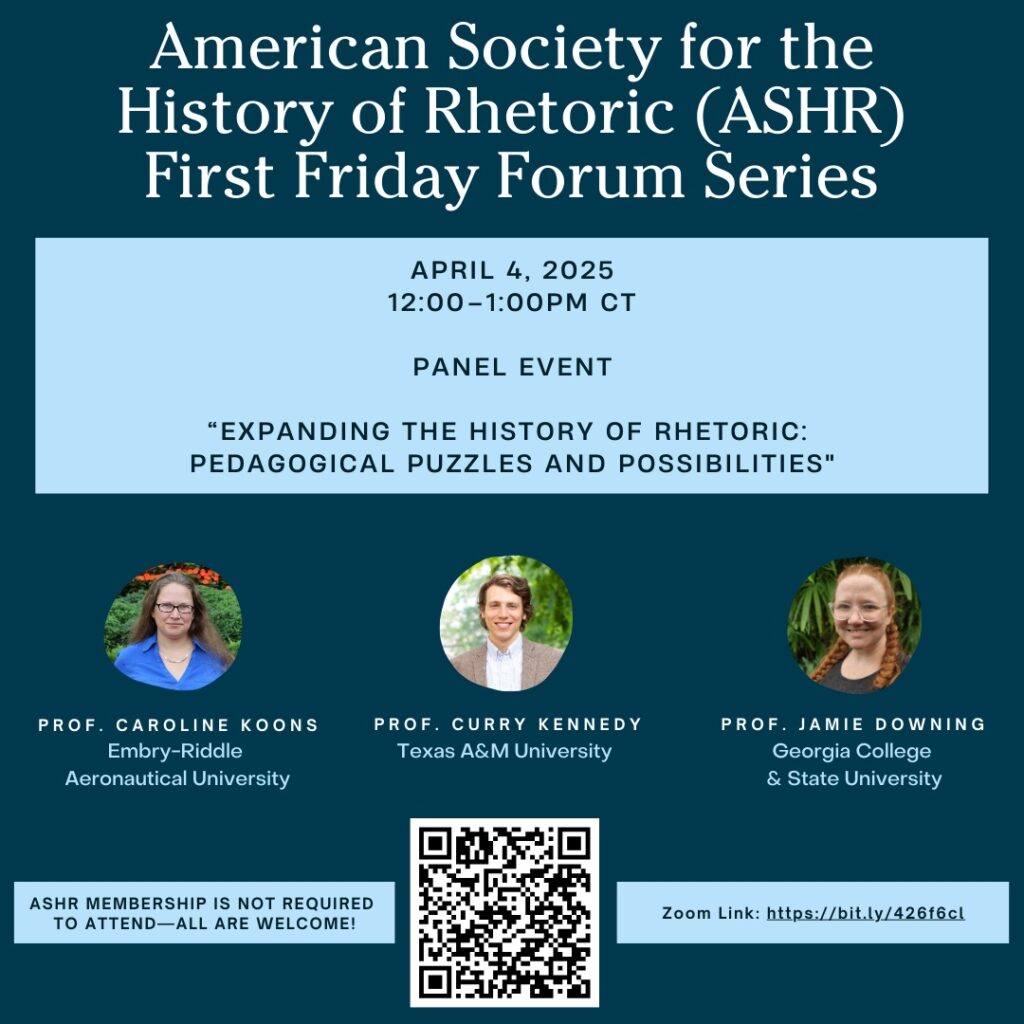
Expanding the History of Rhetoric (Apr 4)

Panel Discussion: Expanding the History of Rhetoric: Pedagogical Puzzles and Possibilities

Friday, April 4 2025

12:00-1:00pm CT

Join via Zoom: https://bit.ly/426f6cl

This month’s forum will explore strategies for teaching an expansive rhetorical history. Curry Kennedy (Texas A&M), Jamie Downing (Georgia College & State University), and Caroline Koons (Embry-Riddle Aeronautical University) will share pedagogical approaches for broadening students’ understanding of rhetorical history, even within curricular structures that emphasize a single tradition. The discussion will highlight ways to present rhetorical traditions as dynamic responses to historical exigences rather than as belonging to a single dominant framework.

Our panelists will speak as editors of the ongoing ASHR Expanding the History of Rhetoric Pedagogy Initiative, which is seeking proposals for pedagogical resources designed to support instructors interested in broadening their approaches to rhetorical history. Accepted authors will receive an honorarium upon successful completion of their materials and publication on ASHR’s website. The full call for proposals can be found here: https://ashr.org/2025/02/expanding-the-history-of-rhetoric-pedagogy-initiative-call-for-proposals-mar-15/

ASHR membership is not required to attend—all are welcome!

About the ASHR First Friday Forum Series: Inspired by the classical conception of the forum as an intellectual gathering place, ASHR’s “First Friday Forum” series promotes educational programming, professional development, and an inclusive, collaborative virtual community. It is our hope that this virtual space will foster dynamic, cross-disciplinary scholarly engagement for those interested in reexamining and reimagining the various histories of rhetoric across all periods, languages, cultures, and modes of performance. The Spring 2025 “First Friday Forum” series will focus on key questions related to the research and teaching of the history of rhetoric / rhetorical history. These virtual gatherings will take place on February 7, March 7, April 4, and May 2, 2025 from 12:00-1:00pm Central Time via Zoom.

Please direct any questions to ASHR Vice President Dr. Allison Prasch (aprasch@wisc.edu) or ASHR Special Programs Coordinator Dr. Kristen Einertson (carl4818@umn.edu).


Call for Proposals: Expanding the History of Rhetoric Pedagogy Initiative (Apr 15)

As part of our ongoing mission to extend and expand the study and teaching of the history of rhetoric across all time periods, places, and cultures, ASHR invites proposals for its Expanding the History of Rhetoric Pedagogy Initiative.

The purpose of this initiative is to support instructors in expanding their educational focus beyond the times, geographies, and vocabularies that most often receive scholarly attention in the teaching of the history of rhetoric. We welcome submissions drawn from the various histories of rhetoric across all periods, languages, cultures, and modes of performance. Each submission should provide an entry point for scholars looking to expand their rhetorical histories beyond the Greco-Roman canon.  We encourage proposals from graduate students, non-tenure track faculty, and early career scholars. 

Submit proposals as a PDF to Jamie Downing (Jamie.downing@gcsu.edu) with the email subject line “ASHR pedagogy proposal” by April 15th. Proposals should include:  

  • An overview of the entry’s topic and scope (300 – 500 words) 
  • A list of the types of courses (graduate and undergraduate) that may find the resource useful  
  • A statement of the author’s interest and expertise (200 words maximum) 

Selected authors will be notified of acceptance in early April with initial drafts of completed resources due by July 1st. We anticipate publishing the completed resources on ASHR’s website (www.ASHR.org) in early August. Upon successful completion of their materials and publication on ASHR’s website, authors will receive an honorarium of $200.  

Completed resources should include:  

  •  A brief introduction to the topic  
  •  A list of courses (graduate and undergraduate) that may find the resource useful  
  • 4-5 main ideas or core premises a unit could be based around  
  • Key terms and definitions  
  • 3-7 primary sources with 2-3 sentence annotations. These might include treatises, speeches, letters, archival documents, videos, podcasts, or digital rhetoric that reflect the principles of the rhetorical tradition under study.  
  • 5-10 academic secondary sources with 2-3 sentence annotations. These provide analyses to some of the primary texts, develop rhetorical theory, and/or contextualize against other rhetorical traditions or concepts.  
  • 5-10 potential discussion questions. 

The editors Jamie Downing (Jamie.downing@gcsu.edu), Caroline Koons (koonsc@erau.edu), and Curry Kennedy (currykennedy@tamu.edu) welcome questions and inquiries.

Tips and Tricks for Navigating the Archive/s (Mar 7)

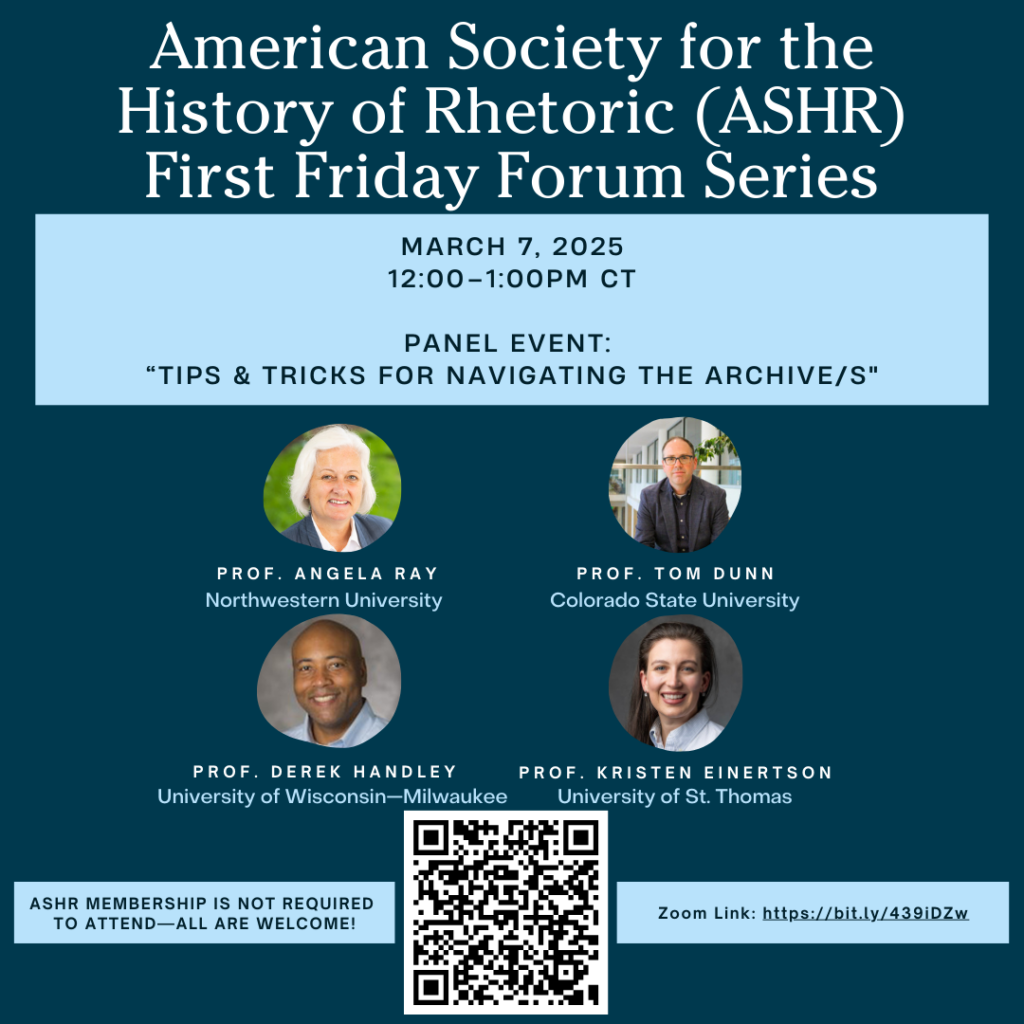
Please join us for a panel discussion featuring four award-winning scholars whose work demonstrates the value of doing archival research: Prof. Thomas R. Dunn (Colorado State University), Prof. Kristen Einertson (University of St. Thomas), Prof. Derek Handley (University of Wisconsin-Milwaukee), and Prof. Angela G. Ray (Northwestern University). 

Panelists will share tips & tricks for identifying online and brick-and-mortar archives related to a research topic/project, strategies for navigating finding aids and working with archivists, and resources for organizing, notating, and deciphering archival finds.

Douglas Day 2025 (Feb 14)

Consider linking up with the Douglass Day 2025 festivities on February 14. This annual event invites scholars from around the country to spend a day transcribing materials from the African American Perspectives Collection at the Library of Congress. Whether you join as an individual or with a group of colleagues + students, this virtual gathering is a terrific way to amplify a vital archive of the US American experience to academics and the larger public.

Visit the Douglass Day 2025 official website here for a formal schedule, transcription details, and publicity resources.

What Do We Mean By the History of Rhetoric? (Feb 7)

ASHR’s Inaugural First Friday Forum

The American Society for the History of Rhetoric (ASHR) is excited to announce a new virtual seminar series for scholars interested in the history of rhetoric, broadly defined. Inspired by the classical conception of the forum as an intellectual gathering place, the “First Friday Forum” series will promote educational programming, professional development, and an inclusive, collaborative virtual community. It is our hope that this virtual space will foster dynamic, cross-disciplinary scholarly engagement for those interested in reexamining and reimagining the various histories of rhetoric across all periods, languages, cultures, and modes of performance.

Our inaugural event (Friday, February 7) will be a panel discussion entitled “What Do We Mean by the History of Rhetoric?” featuring Prof. Katya Haskins (Penn State University); Prof. José G. Izaguirre III (University of Colorado-Boulder), Prof. Caroline Koons (Embry-Riddle Aeronautical University); Prof. Tiffany Lewis (Baruch College, City University of New York); and Prof. Ariel Seay-Howard (North Carolina State University). Panelists will spend 3-4 minutes sharing how their teaching and research intersects with rhetorical history and reimagines what the “history of rhetoric” might mean today. We will leave ample time for forum participants to ask questions and discuss similar questions in relation to their own work.

You can join this inaugural “First Friday Forum” gathering via this Zoom link. ASHR membership is not required to attend—all are welcome!

Please direct any questions to ASHR Vice President Dr. Allison Prasch (aprasch@wisc.edu) or ASHR Special Programs Coordinator Dr. Kristen Einertson (carl4818@umn.edu).

Mentor Award Call (Oct 24)

American Society for the History of Rhetoric Mentor Award 2024 Call for Nominations

The American Society for the History of Rhetoric (ASHR) invites submissions for its 2024 Mentor Award.

The ASHR Mentor Award honors an exemplary mentor in the field of rhetorical studies, whose record of supporting students and other young scholars embodies the standards and values of the discipline. Please submit nomination materials to Jordan Loveridge at j.t.loveridge@msmary.edu. The deadline for nomination is October 24, 2024.

To be considered for the award, nomination materials should include:

§ A 1 to 2-page letter of nomination from the person submitting the materials
§ Up to two additional letters of support from individuals who have worked closely with the

nominee

§ An up-to-date copy of the nominee’s CV
§ Optional: Additional supporting materials, such as representative comments from current

or former students and colleagues, evidence of excellence in mentoring such as previous awards, etc.

Submissions will be evaluated on the following criteria:

  • §  Consistent, on-going, and superlative support for others working on projects related to the history of rhetoric
  • §  Specific support and advocacy for students, community members, and/or colleagues historically marginalized within the study of the history of rhetoric
  • §  Investment in mentorship roles that extends beyond the requirements of the nominee’s paid positions
  • §  Evidence of the mentor’s lasting impact within the field of rhetorical history, on the nominee’s campus, and/or in larger communities

For this year, ASHR membership is not required for award consideration, but please do consider the benefits of joining.

Please submit all materials via email (MS Word or PDF) to the selection committee chair, Prof. Ben Crosby, at ben_crosby@byu.edu.

The deadline for submissions is October 24, 2024.

For more on ASHR awards, including a list of past winners, click here.

Ben Crosby – Professor Department of English Brigham Young University ben_crosby@byu.edu

Dissertation Award Call

American Society for the History of Rhetoric Dissertation Award
2024 Call for Nominations

The American Society for the History of Rhetoric (ASHR) invites submissions for its 2024 Dissertation Award.

The ASHR Dissertation Award honors an exemplary dissertation treating rhetorical history (broadly construed) that was defended between September 2023 and September 2024. ASHR membership is not required for award consideration, but please do consider the benefits of joining.

Please submit all materials via email (MS Word or PDF) to the selection

committee chair, Prof. Jamie Downing at jamie.downing@gcsu.edu. The deadline for submissions is October 13, 2024.

To be considered for the award, please submit:

  • A 1-2-page dissertation abstract
  • The dissertation’s table of contents
  • One representative chapter (Do not send complete dissertations)
  • A letter of recommendation from the dissertation advisor or a committee member that includes the defense date. Recommendation letters can be sent to the selection committee chair by either the applicant or the recommendation writer.

ASHR encourages a pluralistic conception of the history of rhetoric. The selection committee hopes to see dissertations treating histories of rhetoric from around the world that focus on any time period, draw on any type of archive, and use any method of rhetorical or historical analysis. We particularly welcome dissertation projects that contribute to work on diversity, equity, and access through topic, content, citational choices, and/or framing.

Submissions will be evaluated on the following criteria:

  • Significance of the work’s contribution to histories of rhetorical theory, practice, and/or pedagogy
  • Quality of research and analysis
  • Clear, engaging writing style

For more on ASHR awards, including a list of past winners, click here.

Jamie Downing (she/her)
Associate Professor
Department of Communication
Georgia College & State University
jamie.downing@gcsu.edu  

Extended JHR editor deadline

Dear ASHR members,

The Journal for the History of Rhetoric search committee has extended the deadline for applications through May 31st. The initial call for applications is copied below. If you have any questions or concerns, please reach out to the search committee via email.

Call for Applications: Editor, Journal for the History of Rhetoric, 2024-2026/7 Term

The American Society for the History of Rhetoric’s editorial search committee (Jordan Loveridge, Dave Tell, Ekaterina Haskins) invites applications for the next editor of Journal for the History of Rhetoric (JHR). Published by Penn State University Press, JHR publishes quality scholarship on all aspects of rhetoric, in all historical periods, with reference to all intellectual, national, and cultural communities. The journal not only welcomes contributions from scholars who take diverse historical approaches to the study of rhetoric, it also seeks to broaden the realm of historical inquiry into rhetoric by publishing essays that investigate topics, texts, and controversies that have not typically been included in the canon of rhetorical history. JHR’s scholarly scope includes, but is not limited to, argumentation; public address; rhetorical criticism and discourse; the history of rhetorical instruction and pedagogy; historical perspectives on rhetorical theory; the history of rhetoric and social movements; and the relationship between rhetoric and other disciplines and cultural institutions. 

The editor will be appointed to a three-year, renewable term. The editor will be responsible for assembling and appointing a review board, supervising the manuscript review process, and preparing manuscripts for final production. The new editor will work closely with current editor Ned O’Gorman to navigate the transition as they become acquainted with JHR’s publication process. In addition to overseeing all editorial matters associated with JHR, the editor also serves as an officer and Steering Committee of the American Society for the History of Rhetoric (ASHR). 

While the committee welcomes applications from candidates at many career stages, we ask that all applicants hold tenure-line positions. 

Additionally, the committee believes that institutional support is essential for the editor-elect and a central component of the journal’s success. As such, we ask that applicants provide evidence of institutional support as part of their application materials. Typical support includes 1 course release/year and graduate assistance. In addition, ASHR will provide a one-time research and travel stipend of $3,000 to support the editor’s research agenda and engagement with the discipline upon appointment. 

Please forward applications and address any questions to ASHR President Jordan Loveridge (j.t.loveridge@msmary.edu). Applications should include an abridged curriculum vita and short cover letter that speaks to the applicant’s qualifications and editorial vision, as well as the potential for institutional support.  Deadline for applications: May 31, 2024. The search committee will recommend an editor-elect in May 2024.